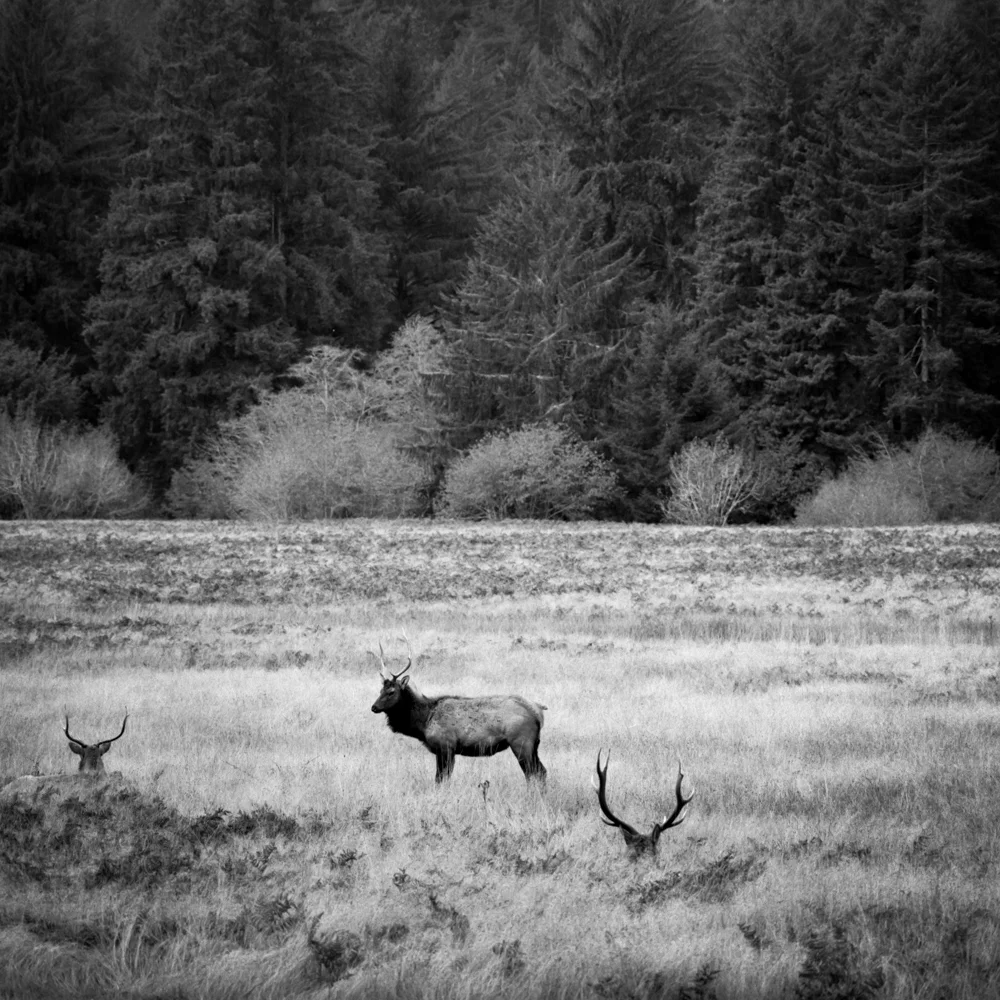
We've been in Indiana for two weeks already, and besides a couple of quick outings, I haven't been shooting much. Yesterday, I decided to stop being lazy about it and just get out. My destination: the Indiana Dunes, some one hour and a half away.
Read MoreShooting film in Goshen, Indiana
A short break from all the road trip videos to show you the little town of Goshen, Indiana.
Last week, I went for a walk around downtown and shot some photos while it was snowing. I loved the atmosphere but unfortunately I couldn't shoot for as long as I would've loved to: it was cold, very cold. I couldn't feel my fingers, nor my toes, after just half an hour.
But I had fun doing something I'm not used to, I got a couple shots I like and I experimented recording this video with my iPhone. I'll be doing it again!
Photos were taken using HP5+ and FP4+, both from Ilford.
You can find some of those photos in the Indiana archive.
Pier 43, San Francisco, November 2017
Camera and Lens: Bronica SQ-Ai, Zenzanon PS 150mm f/4
Film stock: Ilford HP5+
Exposure: 800
Developer: Kodak D76
While our week in San Francisco was mostly about spending time with family, I got some time to take some shots by waking up really early every morning.
My main goal was to shoot the Golden Gate in the fog, and maybe some random exploration of the city. I wasn't expecting to go to Fisherman's Wharf at all but somehow, I ended there one morning before the crowds arrived.
This is how I got this shot without having another 25 people in front of me.
As I said before, wake up and get out.
About the shot itself, I only wanted an exposure of this arch so I waited a few minutes until the pidgeons were doing something interesting around it. It was very hard to tell what the shot would look like, but I tried my best to get the contrast between the dark birds and the white arch.
I was hoping for more, but I got 4 where I wanted. Plus the ones resting on top of the arch. Overall, I like how it turned out. But next time, I might want to take 2 or 3 shots to increase my chances.
More photos: Archive -> San Francisco
Sea lions at Point Arena, CA, November 2017
Camera and Lens: Bronica SQ-Ai, Zenzanon PS 150mm f/4
Film stock: Ilford HP5+
Exposure: 800
Developer: Ilfotec HC
Point Arena was one of my favorite spots in the Mendocino area, and that's why I went there twice leaving behind some other places.
The first day I got rain and fog. The second time I got Sun and a very bright day.
As you can imagine, this image was made on the first day. It's a long exposure of some sea lions hanging out on those rocks. I was hoping they wouldn't move too much for a few minutes so they'd still look sharp enough. And looks like I was right, they didn't move a lot.
You can find more photos from Northern California in the archive.
American Road Trip Journal #12: The Lost Coast
Episode 12 of the American Road Trip Journal.
On this episode, I drive to the Lost Coast. Still in Northern California, and still on the same day - this happens after we went to the Fern Canyon.
The Lost Coast is a mostly undeveloped part of the coast of California. There are a few small, remote towns and not much else. There are some roads but they are pretty bad: it took me almost 2 hours to reach the coast from Eureka.
From there, you have miles and miles of coast to explore. You'll find some livestock roaming on private property you can't trespass, so don't expect to be able to go anywhere you want.
For that, you might want to head further south, where the road doesn't reach. The King Range mountains await you there: you can either climb them or hike along the coastal trail.
But of course I didn't have time for any of that in just one afternoon / evening. I barely got any time to spend there, but managed to take a few shots I'm happy with.
Bronica SQ-Ai review for Emulsive
I wrote a little review of my beloved Bronica SQ-Ai for Emulsive that you can read here.
"Lone Tree" - Lee Vining, December 2017
Camera and Lens: Bronica SQ-Ai, Zenzanon PS 80mm f/2.8
Film stock: Ilford HP5+
Exposure: 800
Developer: Ilfotec HC
Near the town of Lee Vining, approaching Mono Lake, at dawn.
I was on my way to the tufas that morning, and with the Sun almost peaking out in the horizon, I had not much time to spare. But then I saw this tree on the left side of the road, and I had to stop and take an exposure.
The fog was accumulating in the lake just behind the tree, that stood dark as no light was hitting it. The sky was already bright from the approaching sunrise.
A scene that really depicted this place.
"Ghosts of Mendocino" - Mendocino Headlands, November 2017
Camera and Lens: Bronica SQ-Ai, Zenzanon PS 80mm f/2.8
Film stock: Ilford HP5+
Exposure: 800
Developer: Kodak D76
You can't go wrong with the Mendocino area at sunset time. This photo was taken from the Mendocino Headlands, a long exposure of about 5 minutes using an ND Filter.
You can notice a person on top of the rock. I thought he'd be there for just a few seconds and leave, so he wouldn't be in the image at all. But that guy stood there for more than a couple minutes - or half of my exposure. I knew he was going to be there, somehow.
But I like the result! He's still easily removable from there but I decided to kept the ghostly figure. I think it adds something to the photo and maybe... just maybe... even tells a story (stories in landscape photographs is something I've thought a lot about, and I don't think it's a thing... but this might be a good topic for a whole new post).
In defense of "car photography"
This might be one of the biggest misconceptions about landscape photography, and some might frown upon but I'm going to say it: you don't have to go deep in the wilderness to take amazing landscape photos. In fact, a lot of the greatest shots were taken either from a car or from the side of the road.
Read MoreIndiana Diary I
"Cloud Hug" - Oregon Dunes, November 2017
Camera and Lens: Bronica SQ-Ai, Zenzanon PS 150mm f/4
Film stock: Ilford FP4+
Exposure: 125
Developer: Kodak D76
Notes: an orange filter was used
While photographing the Oregon Dunes, I noticed this cloud that was forming a few miles away. It was just behind a hill and I couldn't tell if it was touching the ground or not but in any case, it was very low.
Everything happened really fast: I was taking shots of the ground behind a big dune, the shape of the cloud quickly changed to what you see here, almost like ready to hug or eat the grove of trees (I swear I can even see a face).
I took 2-3 shots of it trying to use the dune to my advantage, hiding the otherwise very busy foreground to keep the cloud as the main and only subject of the image.
I wanted more exposures without that dune though, but by the time I as able to go around it the cloud had already changed to something different and not as interesting.
Another lesson to be learned: when there's weather like this, windy and clouds forming and dissapearing so fast, keep an eye on them at all times and be ready!
Watch the video about this trip: American Road Trip Journal #8: Oregon Dunes and Heceta Head Lighthouse.
250mm vs 2x Teleconverter + 150mm f/4 lens: pretty much the same size
Zenzanon PS 2x Teleconverter vs Zenzanon PS 250mm f/5.6 lens
A few months ago, I bought a Zenzanon PS 2x Teleconverter. I thought the combination of 150mm + teleconverter could replace the 250mm and make for a lighter system. Turns out, I didn't really use it too much. But as we are getting ready to move overseas, I'm faced with the same question again: portability or better quality, teleconverter or long lens?
Read MoreNot so lost coast, November 2017
Camera and Lens: Bronica SQ-Ai, Zenzanon PS 250mm f/5.6
Film stock: Ilford HP5+
Exposure: 800
Developer: Kodak D76
First thing you see when you arrive to the Lost Coast (from Eureka) is this settlement. You guess it's not so lost after all. But then you see that there's pretty much nothing else after that: not even a road after a few miles.
This was taken from Mattole Road, on the way to Petrolia.
I tried to capture the vastness of this place, contrasting it to these few buildings. How they were built in probably the only somewhat protected spot.
I used the 250mm lens, but the 150mm might have worked as well. The longer lens allowed me to place the "town" all along the foreground though, with the road leading towards the horizon and the emptiness.
How to photograph the Fern Canyon (Redwoods National Park)
American Road Trip Journal #11: Fern Canyon
This is not an easy place to photograph! And it's even harder in black and white. I wasn't prepared and that shows in my photos, they are not good... at all.
You need to find a strong composition to succeed here, and that requires some time. I didn't have that time (and you probably won't either unless you are prepared - it gets very cold once your feet get wet) and that shows on my shots: they are bad.
I made several mistakes, the first one was to use wide apertures and short exposures. I did this because my first shots were handheld and also because there was some wind that was moving the ferns.
Possible approaches to capture this canyon in these conditions?
- take longer exposures of the canyon using smaller apertures, f/11 at least to get most of it in focus.
- close-ups of the stunning vegetation, the walls of ferns are very cool. You'll need wide apertures here to compensate for the wind, but it will be easier to keep your subject in focus.
- try to take silhouettes of the trees and the top of the canyon against the -most likely- overcast sky.
We didn't see them there -we ran into them later that morning though, in a different area of the park-, but there are elk and they can be aggressive. But I'd be prepared just in case you find them and they are far enough to take some safe shots.
From the trailhead, you can access a beach. We didn't because, you know, no dogs in national parks, but probably another good place to take some shots before heading out.
Mendocino Headlands, November 2017
Camera and Lens: Bronica SQ-Ai, Zenzanon PS 150mm f/4
Film stock: Ilford HP5+
Exposure: 800
Developer: Kodak D76
The coast of Mendocino is stunning, showcasing incredible rock formations and intimidating cliffs.
Compared to the coast just a bit further north, you can notice an obvious difference: the lack of trees.
This can be a blessing for landscape photography, since you don't have to go down dangerous slopes trying to find a vantage point. It comes with disadvantages though: the landscape can look dull at times.
Here, I found a nice spot where the combination of some (but not too many) trees and the coast create a frame that I really like. I actually took a few exposures here trying to create the effect I was after.
I knew I wanted no details on the trees, just almost pure black silhouettes against the rough sea in the background. The trees were not as simple as I'd wish for, so I tried to include some empty space -both in the foreground and the background- to make the photo a bit less busy.
Trinidad, November 2017
Camera and Lens: Bronica SQ-Ai, Zenzanon PS 150mm f/4
Film stock: Ilford HP5+
Exposure: 800
Developer: Kodak D76
I took this shot during an evening walk, just after sunset, in the small but charming little town of Trinidad, in Northern California.
It was breezy and cold, intermitently drizzling. But this is the kind of landscapes that inspire me and that I love so much.
There were quite a few people on the dock, fishing and hanging out with friends and family.
I framed this composition from an elevated spot, trying to capture the drama that the mist was creating just at the other side of the bay.
I thought of taking a long exposure, but the weather conditions made me think otherwise. In retrospective, I believe this shot is stronger this way and it captures the roughness of the sea on a cold November evening.
American Road Trip Journal #11: Fern Canyon
Finally, a new episode of the American Road Trip Journal is here!
As you might have already guessed by the name, this canyon is covered in ferns. Located in the Redwoods National and State Parks in Northern California, it got some fame after a guy named Steven Spielberg chose it to film a scene for Jurassic Park II in this canyon. NBD.
Read MoreCountry road, take me home...
American Road Trip Fun -and not so Fun- Facts
- We were on the road for 54 days
- We saw some of the tallest trees on Earth - the Coastal Redwoods
- I saw some of the oldest trees on Earth - the Bristlecone Pines in the White Mountains
- We woke up with a view of the tallest peak in the contiguous 48 for 7 days in a row - Mt Whitney
- I walked on the lowest point in North America - Badwater Basin
- I drove through the city with arguably the worst traffic in the country - LA
- We drove 10,000 miles
- 13 states - WA, OR, CA, NV, AZ, UT, NM, CO, TX, OK, MS, IL, IN
- Camped with the waves of the ocean as background noise in Salt Point in California, then another two nights under the star of the stunning desert night sky in Joshua Tree (CA) and Valley of Fire (NV)
- We stayed at 15 different places. That means we had to "move" 15 times...
- ...and I say "move" because we were carrying everything we own with us. We believe we didn't lose anything.
- We had to leave one of those places at 2am because of some crazy dudes pounding our door.
- We ran into very nice, and very rude people.
- Our diet could have been better, having a kitchen at some of the places helped a lot.
- I lost count of how many sunrises I witnessed. It doesn't get boring though.
- I shot and developed some 70 rolls of 120 film. I took hundreds of digital photos, a few rolls of 35mm and dozens of videos.
- I miss it already.
- This is a vast, and beautiful country!
Road to the Lost Coast, November 2017
Camera and Lens: Bronica SQ-Ai, Zenzanon PS 150mm f/4
Film stock: Ilford HP5+
Exposure: 800
Developer: Kodak D76
The Lost Coast, one of the last -mostly- undeveloped streches in the California coast. And it shows: the road to get there from Eureka is... bad. But once you get there, the dozen potholes you hit during the past hour become part of the past.
I took this photo where the road starts its way down to meet the ocean. From there, you have several miles of beaches you'll get to enjoy by yourself. They aren't the kind of beaches you are going to get a tan on though. And I love it.
I wanted to create 3 layers in this photo: the road, the rock in front of the ocean, and the sky.
The road leads to the needle without taking most of the frame. The use of the 150mm helped giving it the importance it deserves, but also "compressing" the background that in this case is the main subject.
I thought about placing the horizon lower (respect to the needle) but I went with this approach at the end: the top of the needle "touches" where the sea and sky meet. I think this creates some empty space that helps in an already busy composition.
Bronica SQ-Ai (body pictured here), my medium format camera of choice
How much does it cost to shoot medium format film? My Bronica SQ-Ai numbers
I think we all know that shooting film comes at a cost, literally. And the bigger the chunk of film you expose every time you open that shutter, the worse it gets.
But how much money are we talking about, exactly? Let me show you my numbers, how much I spent on my gear and how much I spend every time I shoot with my Bronica SQ-Ai.
Read More