I wish the fog lasted a little bit longer these mornings, I can't get enough of it!
I captured these images during my walk yesterday.
Read MoreI wish the fog lasted a little bit longer these mornings, I can't get enough of it!
I captured these images during my walk yesterday.
Read MoreI love shooting square, so of course I had to talk about this new initiative by @andrewmcclees to promote the square format.
During this month of September, @squaretember will be featuring some of the images shared with the hashtag #squaretember.
The only requirement: the photographs have to be shot natively in square format, no cropping.
Go ahead and share your square images!
First day of the month, and there's a new print for the Image of the Month series of prints.
After The Last of Winter and A New Beginning, I chose A New Day for this month of September.
Read MoreCamera and Lens: Sony a6500, 16-70mm f/4 Carl Zeiss
Settings: 51mm, ISO 100, f/7.1, 1/500sec
On way back from my failed trip to Lugo (that became a Medium Format vs APS-C experiment), I saw some low clouds on the mountains and decided to take a little detour.
I love driving these roads, you never know what you can find. There are so many of them!
This time was no different. I stumbled upon a few cool trees, and then I saw this one. I had never seen one like this around here. It looked like a super-sized bonsai.
I had to capture it, of course.

Yesterday, just for fun, I ran a little experiment and shot the same compositions with both the Bronica and the Sony a6500. Then, I tried to create the same images from the negatives and RAW files and compared them.
The results? (Un)surprising!
Read MoreCamera and Lens: Sony a6000, Meike 35mm f/1.7
Settings: ISO 100, 1/125sec, aperture unknown
Even though we had to call this boat ride short because everyone was cold, I loved that time on the lake that foggy evening.
Calm waters, no one around but a handful of fishermen... so relaxing and beautiful.

Taking long exposures on film can be trickier than doing it with a digital camera.
Don't be afraid, though! After getting familiar with a couple of gotchas, you'll find the process pretty straightforward.
And I actually like the results much more than the ones I get with digital!
In this week's chapter of the Long Exposure Photography Series we will talk about what's different, the downsides and the advantages of using film for long exposures.
Read MoreCamera and Lens: Sony A7ii, Sony 16-35mm f/4
Settings: 16mm, ISO 100, f/5.0, 1/80sec
Mt Rainier National Park is one of those places that you have to see in person to believe they are real.
The star of the park is, obviously, Mt Rainier. But every corner looks like a fairy tale.
I'm a winter person, I don't like much about the summer. The heat, the crowds, the hars light... none of them.
It's usually a bad time for me to go out and make images, so I spend most of the summer inside writing, editing and reading.
This year, I came up with 6 different photography ideas to try. From a homemade pinhole lens to use oil from a can of tuna to emulate the Holga look:
#1 Photographing the clouds
#2 Homemade pinhole lens
#3 Fireworks
#4 Night photography in a forest
#5 The Holga Look
#6 Infrared
It was fun and I learned a lot from every one of these projects. I hope at least one of them inspires you to try something different!
Camera and Lens: Bronica SQ-Ai, Zenzanon PS 150mm f/4
Film stock: Rollei IR400
Exposure: 12
Filters: Hoya R72
Developer: Rodinal
This was my first time shooting infrared with film, and I'm very pleased with the result. I will be doing it again soon!
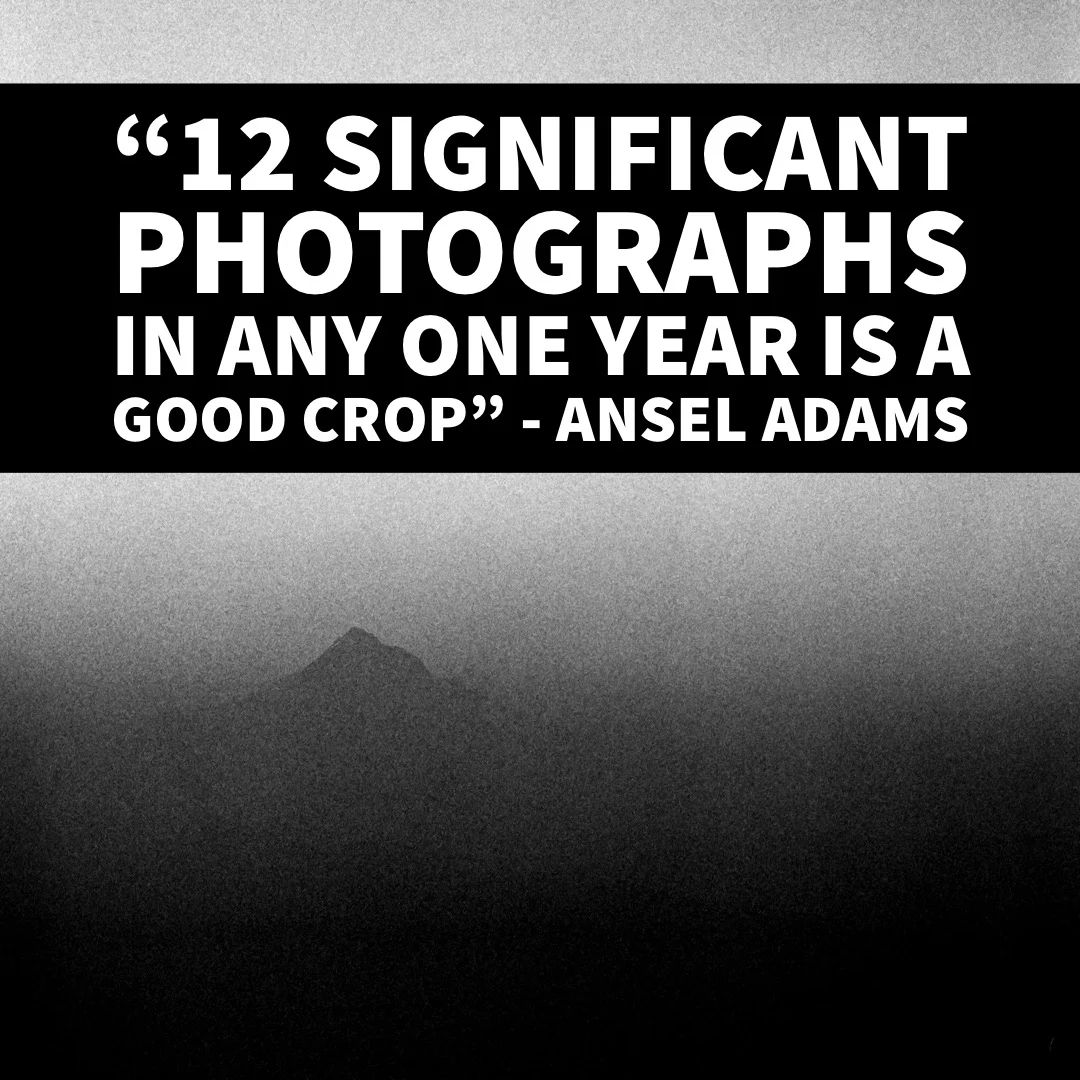
This quote by Ansel Adams is used quite often, perhaps to motivate photographers who feel they aren't making enough good images. A few images this year, a few more next year, and so on can become a significant body of work over time.
I have 2 problems with this approach, though.
Read MoreI really didn't want to wake up, it was still early and I needed the sleep if I wanted to catch the sunrise as I had planned. But the storm insisted, getting louder and the lightning more often and brighter. It was relatively close and the whole bedroom would light up.
Bye, sunrise. I got up and set up the camera. The storm moved away quickly, but before it did, I was able to get a couple of good shots.
Read MoreThe full moon is here. Last night was going to be my best chance to make a photograph of a moonlit landscape -clouds are coming for the rest of the week.
I wanted to make a long exposure of the full moon above a nearby canyon. I thought it'd be a cool image.
This place is not remote. Still, the closest town is a few kilometers away. I drove there and parked the car in the empty parking lot around 11pm. There's a viewpoint where I was planning to make this image from.
The moon was still rising above the walls of the canyon, so it was pretty dark outside. I grabbed my phone and turned on the flashlight, and opened the door.
As soon as I stepped out of the car, I heard it. It was a shot. I didn't know if it was a gun, or a shotgun, or something else. I didn't know in what direction. But it was close.
In retrospective, and having talked to some people, I believe it was a device used by locals to scare the wild boars from the vineyards that populate the landscape of the area. I'd never heard it before, but they say it sounds like a gun.
At that time, being alone in the dark in a place where I thought there was no one, it didn't feel that way.
I got out of there as fast as I could.
Probably a place I won't be visiting at night again.
Camera and Lens: Bronica SQ-Ai, Zenzanon PS 50mm f/3.5
Film stock: Ilford HP5+
Exposure: 800
Developer: Ilfotec HC
What a view. Enough said about this place.
Have you ever thought about what your dream camera would look like?
Mine would look something like this.
I want a mini Bronica SQ. Smaller and lighter, using a new type of film for 5x5 frames, 16 exposures per roll.
The viewfinder would stay the same, a little smaller due to the overall size reduction. You'd be able to switch to a fully electronic viewfinder (very much like the Fuji X100 series) with a live preview of the exposure and the film you have loaded in the back. This preview can simulate pushing and pulling as well.
If you run out of batteries, it should still work using the optical viewfinder.
I'd like to have just one lens, a zoom lens with a range of 20-300mm. f/4 would be more than enough.
When taking a long exposure, it should be able to show you the image as it's being "built". Of course, simulating the effect film will have on it. This way, you could stop it once it looks good and not before or after.
This would be the perfect camera for a hybrid shooter.
What would yours look like?
There are few places that feel like the Old West the way Monument Valley, Arizona, does.
We missed sunrise and sunset due to the long drive to get there from Flagstaff, but still enjoyed our time at this beautiful Indian reservation.
Camera and Lens: Bronica SQ-Ai, Zenzanon PS 80mm f/2.8
Film: Ilford HP5+
Exposure: 800
Developer: Ilfotec HC
They weren't. They hadn't for a while.
If there's a place in the US where you can feel like being in a western, that's probably Monument Valley.
“Rather than shooting in colour because a subject calls for it, people tend to do so because that’s how their camera is set up. And all too often people compose their shot using the language of colour and then hope that it will translate into black and white later. Neither of these approaches work.”
Many people use monochrome to "fix" a bad photo. Others seem to have doubts about which version they prefer, so they post both: color and black and white.
While you can get good results every once in a while, this approach is wrong.
The tools you have available in black and white photography are very different from the ones you can use when shooting in color. The image should be in your mind first, then -and only then- we can choose whatever tools we need to create it.
Camera and Lens: Sony A7II, Sony 16-35 f/4
Settings: 16mm, ISO 800, f/4, 1/25sec
A year after I made this image, a wildfire that burnt a lot of the Columbia River Gorge started near this spot. As of right now, it's still closed.
I never made it to the end of this beautiful hike, but I hope the trail will be open next time I visit the Gorge.
Camera and Lens: Sony A7II, 28-70mm f/3.5-5.6 kit lens
Settings: 70mm, ISO 500, f/5.6, 1/80sec
I don't know what I was thinking that day. From Timberline Lodge, I started walking up, and up. It was cloudy, but otherwise a nice day.
When I was close to Palmer lift, at around 8,500ft, the weather started to change: the clouds I had been photographing a while ago reached all of us up there, and it was like being in the middle of a blizzard.
Luckily, it's easy to find your way back from there, and after just a few minutes walking the weather got back to calm.
But in the middle of all of that, I got this image of two hikers coming back down to safety.